Meta Launches Muse, an Autonomous Personal AI Agent Powered by Isolated Cloud VMs
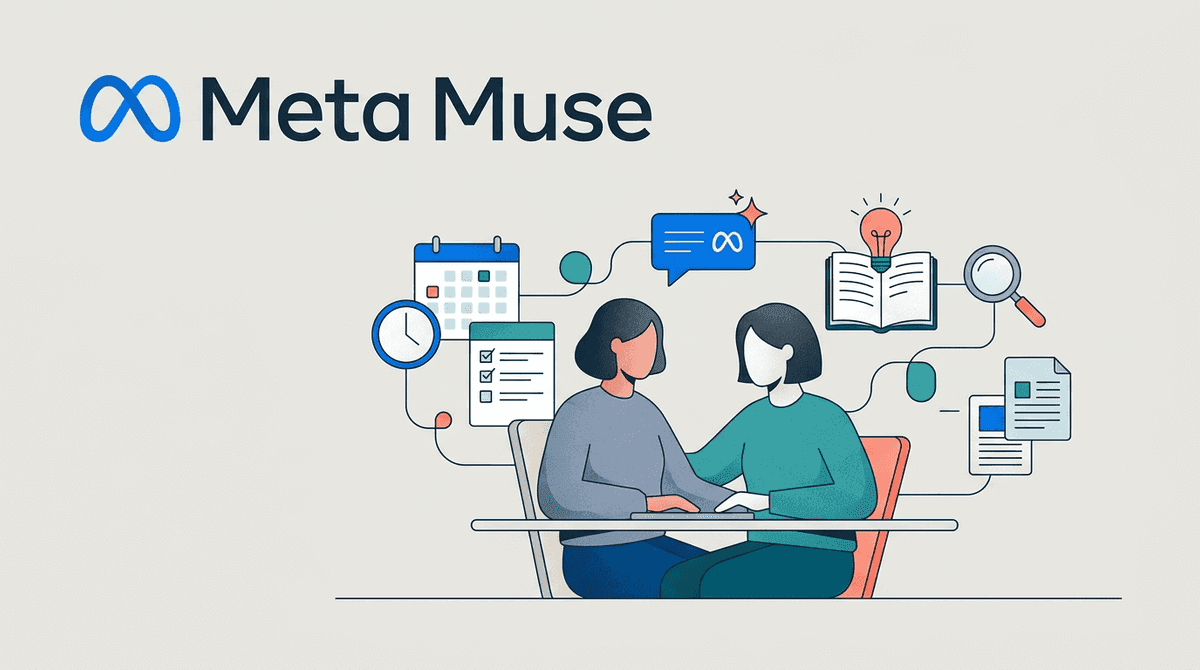
Meta has officially launched Muse, an autonomous personal AI agent designed to execute complex, multi-step tasks across a user's daily digital life. Available on web, mobile, and WhatsApp, the agent pairs general reasoning with background workflow automation. Unlike standard conversational chatbots that merely suggest actions, Muse provisions an isolated cloud Linux virtual machine for every user, mediating sensitive credentials and external web actions through an independent security authority named Sentinel.
What’s New
- Provisions a persistent, isolated Linux Virtual Machine per user with restricted syscalls and systemd containerization.
- Operates across desktop, native iOS and Android apps, and directly inside WhatsApp messaging threads.
- Separates planning from execution using Sentinel, a host-level security authority that gates all network and connector actions.
- Uses eBPF kernel tracking to taint processes handling sensitive user data, enforcing mandatory user approval before egress.
- Stores OAuth credentials locally in user VMs via hatch-authd, passing only surrogate tokens to the agent runtime.
- Protects consumer privacy by explicitly walling off all agent VM state and conversational data from Meta's advertising systems.
Why It Matters
By granting an autonomous agent its own virtual machine, Meta solves the computational sandboxing challenge that hobbles browser extensions and chat interfaces. However, convincing consumers to entrust sensitive accounts and payment authorizations to an automated background runtime will depend entirely on how reliably Sentinel stops prompt injection attacks in the wild.
Meta has officially introduced Muse, an autonomous personal AI agent built to plan, execute, and coordinate complex tasks across consumer applications. Developed within Meta Superintelligence Labs and rolling out across web, native mobile apps, and WhatsApp, Muse marks a strategic shift from passive chat interfaces toward autonomous agents capable of performing multi-step operations in the background.
While conventional assistants require users to supervise every action in an open browser tab, Muse executes tasks inside an independent, persistent Linux cloud environment known as the Muse Secure VM. Each user receives a dedicated virtual machine running an unprivileged systemd container with restricted system calls. This sandboxing architecture isolates code generation, tool invocation, and web scraping away from both the host machine and other tenant workloads.
Security and privilege separation form the foundation of Meta's implementation. Rather than permitting the generative model to directly call third-party APIs or execute financial transactions, Muse decouples cognitive planning from external execution. An independent, host-side daemon named Sentinel serves as the sole policy enforcement point. When Muse decides to send an email, reserve a flight, or access an external service, it can only propose an intent. Sentinel evaluates the request against active user permissions and determines whether the action requires explicit human confirmation.
To counter malicious prompt injection from untrusted web pages, Meta deployed kernel-level extended Berkeley Packet Filter (eBPF) telemetry inside the VM. The instant an agent process reads confidential user context, such as email archives or personal calendar entries, the system marks the process memory as tainted. Once tainted, the runtime automatically revokes silent network allowances, requiring interactive approval from the user before transmitting any data out of the environment.
Credential handling relies on an internal daemon called hatch-authd. Authentication tokens and OAuth keys remain stored strictly inside the user's isolated VM instance rather than in centralized corporate directories. The agent code never inspects raw tokens; instead, it uses surrogate identifiers that Sentinel substitutes with genuine credentials at the network perimeter only when approved outbound requests occur.
The integration with WhatsApp provides Meta with immediate consumer reach that competing agent platforms lack. Users can trigger background research, request itinerary updates, or review interactive artifact dashboards directly within existing chat threads. For commercial transactions, Muse integrates with single-use virtual payment cards, shielding underlying banking details from merchant portals.
Meta confirmed that conversations and VM contents associated with Muse will remain isolated from the company's core ad-targeting infrastructure. To pressure-test the architecture against emerging jailbreaks, Meta has launched a dedicated public bug bounty program offering awards up to $300,000 for verified vulnerability reports.