NVIDIA Releases Open Physical-AI Tools for Surgical and Hospital Robotics
At GTC 2026, NVIDIA announced a suite of open physical-AI models and simulation frameworks engineered to transition healthcare robotics from passive computer vision to spatial reasoning and autonomous physical action. The platform equips surgical instruments and hospital service robots with the ability to perceive complex medical environments and assist clinical staff safely.
What’s New
- Launches foundational physical-AI vision-language-action models specifically tuned for medical environments.
- Provides high-fidelity physics simulation via NVIDIA Omniverse to train surgical robots safely.
- Enables autonomous hospital service robots to navigate sterile corridors and transport supplies.
- Introduces sensor fusion libraries connecting endoscopic video, tactile feedback, and spatial sensors.
- Distributes models openly to accelerate medical device research across healthcare institutions.
Why It Matters
Bringing generative models into operating rooms and busy hospital corridors requires uncompromising physical safety guarantees. NVIDIA's open simulation stack provides the reproducible sandbox needed before physical medical robots touch patient care.
During its annual GTC conference, NVIDIA announced a significant expansion of its robotics and healthcare ecosystem, unveiling open-source physical-AI models and simulation environments specifically engineered for medical procedures and hospital operations. The initiative marks an evolutionary transition in medical robotics, moving past hardcoded mechanical automation toward intelligent machines that comprehend three-dimensional physical space and execute contextual tasks alongside healthcare providers.
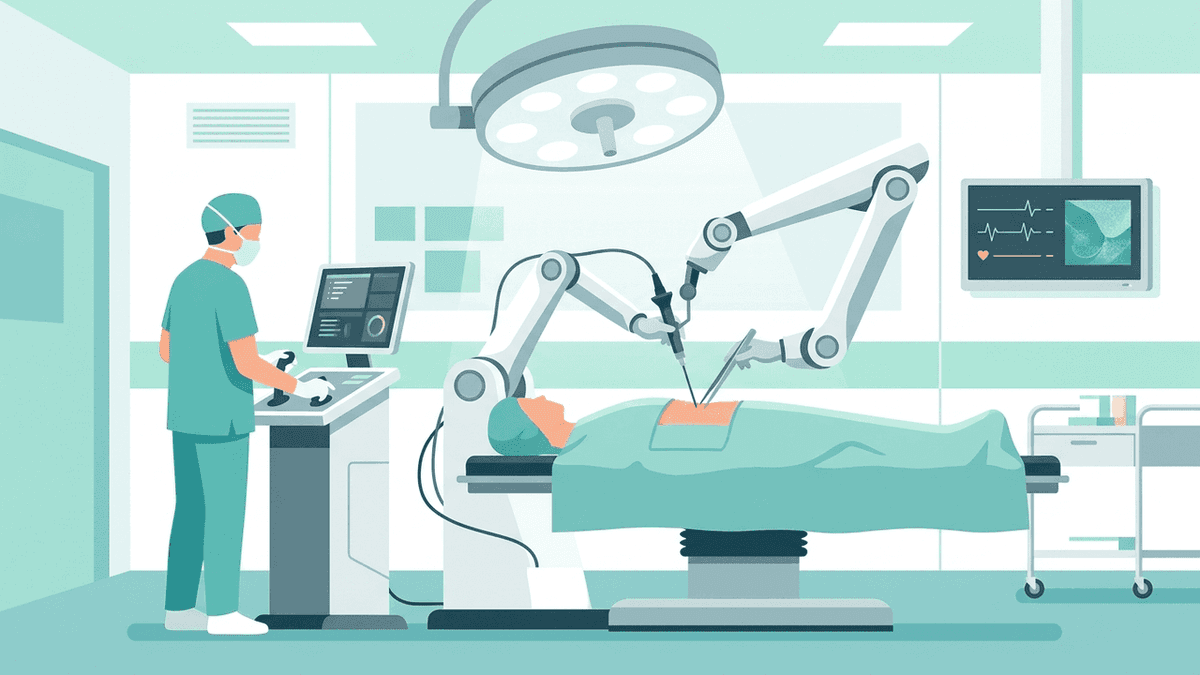
At the core of the announcement are specialized vision-language-action architectures integrated with NVIDIA's Isaac robotics platform. While traditional surgical robots function as mechanical teleoperation extensions controlled entirely by human surgeons, physical-AI models process real-time endoscopic camera streams, depth sensors, and tactile feedback. This allows the system to identify anatomical structures, predict tissue deformation, and assist surgeons with automated camera positioning and instrument tracking during delicate procedures.
Beyond operating rooms, NVIDIA introduced frameworks for autonomous hospital logistics. Operating within complex clinical environments demands sophisticated spatial reasoning to navigate busy hallways, interact with automated door locks, and avoid beds, medical equipment, and pediatric patients. Using physics-accurate simulation in NVIDIA Omniverse, hospital administrators and robotics manufacturers can train navigation and delivery robots across photorealistic digital twins before deploying physical units onto hospital floors.
To foster industry-wide adoption, NVIDIA is making these foundational models and synthetic training datasets openly accessible to researchers and medical equipment manufacturers. The open distribution model aims to lower development barriers for universities and biomedical startups constructing specialized assistive care machinery.
The physical-AI tools are available immediately through the NVIDIA NGC catalog and Isaac developer suite, with production deployments supported on NVIDIA Thor and Jetson edge compute modules.