Google Launches Gemini 4 Argon: 1M Output Window and 77.9% DeepSWE
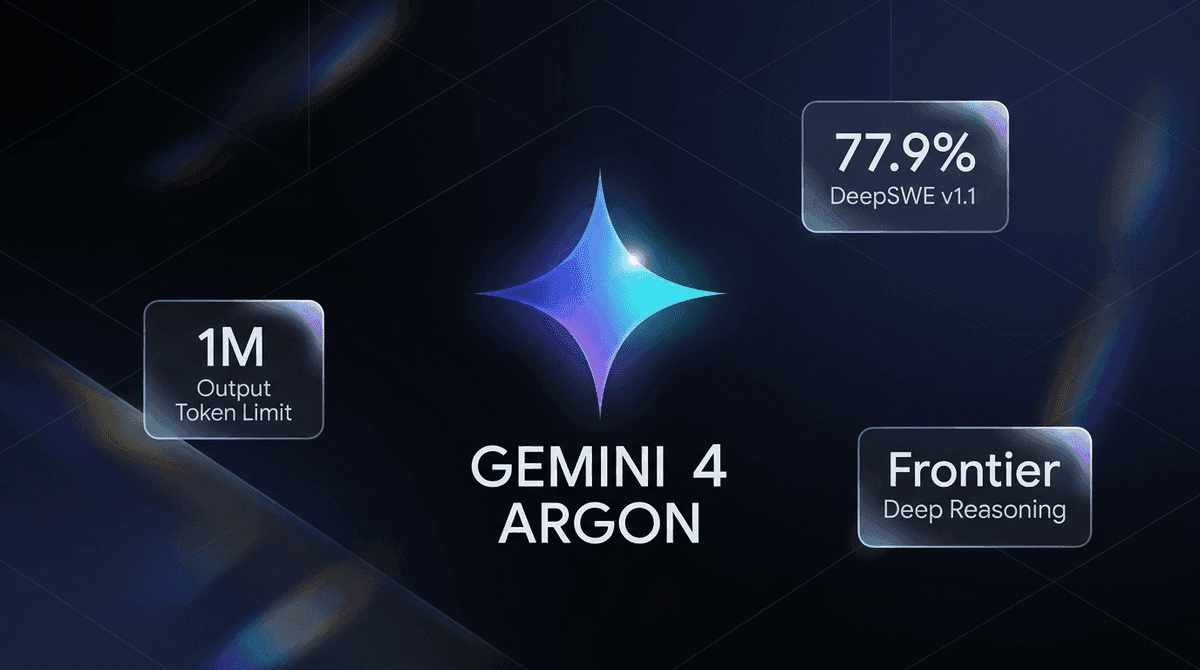
Google DeepMind has introduced Gemini 4 Argon, a frontier reasoning model engineered for long-horizon autonomous execution. Featuring an industry-first 1-million-token output limit and a 77.9% state of the art score on DeepSWE v1.1, the model is already driving large-scale C++ to Rust migrations across Google infrastructure.
What’s New
- Expands the model output generation window to 1 million tokens, supporting multi-hundred-thousand token autonomous reasoning trajectories.
- Establishes a new state of the art on DeepSWE v1.1 with a 77.9% resolution rate across real-world software engineering benchmarks.
- Actively powers internal Google infrastructure rewrites, migrating C and C++ codebases like Fuchsia Zircon to memory-safe Rust.
- Ranks number one across economic impact benchmarks including the Vals Index and AutomationBench (51.3%).
- Rolls out first to trusted cyber defenders via the Fairwind Program with introductory API pricing at $2 input and $10 output per million tokens.
Why It Matters
Gemini 4 Argon redefines agentic software engineering by expanding generation capacity to 1 million output tokens. By eliminating artificial trajectory cutoffs and delivering 77.9% on DeepSWE, Google proves that production-grade autonomous refactoring is ready for critical enterprise systems.
Google DeepMind has unveiled Gemini 4 Argon, a frontier foundation model designed to sustain complex, long-horizon reasoning across software engineering, enterprise automation, and cybersecurity defense. Announced by Koray Kavukcuoglu, Chief AI Architect at Google and SVP of Google DeepMind, the model introduces a fundamental shift in model execution capacity by expanding its output generation limit to an unprecedented 1 million tokens.
Where earlier frontier systems were bottlenecked by output caps of 32,000 to 64,000 tokens, Argon is engineered to produce multi-hundred-thousand token chains of thought and multi-file codebases in a single continuous trajectory. This capacity enables autonomous agents to plan, execute, debug, and verify complex technical deliverables without losing execution context or relying on lossy intermediary summaries.
The 1M output window and autonomous engineering scale
The central architectural breakthrough of Gemini 4 Argon is its 1-million-token output ceiling. According to Google DeepMind, removing output horizon constraints allows the model to think through deeply nested algorithmic bottlenecks and iteratively test solutions across expansive execution loops.
Google is already deploying Argon across its own mission-critical production infrastructure:
- Massive C++ to Rust Codebase Migrations: Teams of Argon agents are actively translating legacy C and C++ codebases into memory-safe Rust. Projects range from core regex engines like re2 and the libgav1 video decoding library to the 800,000-line Fuchsia Zircon kernel. In libgav1, Argon replaced 32,000 lines of SIMD assembly with profile-guided, auto-vectorized safe Rust that runs 2.7 times faster than existing ports while maintaining bit-identical output.
- Datacenter Fleet Memory Optimization: Argon agents analyzed fleet-wide profiling telemetry across Google datacenters to identify memory allocation inefficiencies. Early rollouts recovered over 300 TiB of physical memory, with full fleet deployment projected to save between 500 TiB and 1 PiB of server capacity.
- Quantum Resource Optimization: In quantum algorithmic research, Argon optimized the spacetime resource footprint (qubits multiplied by quantum gates) of bottleneck subroutines, beating published academic baselines by 40% in minutes.
Benchmark dominance in coding, enterprise work, and perception
Gemini 4 Argon posts top-tier evaluations across specialized professional domains:
- DeepSWE v1.1: Argon establishes a new industry benchmark with a 77.9% resolution rate, pulling ahead of both open-weight and closed commercial competitors on long-horizon GitHub issue resolutions.
- Economic Impact and Enterprise Automation: On the GDP-weighted Vals Index, which evaluates economic task completion across finance, law, coding, and tax, Argon claims the number one overall ranking. It also leads the Vals Finance Agent v2 benchmark and Harvey AI's Legal Agent Benchmark for contract drafting and multi-filing regulatory research.
- AutomationBench: On Zapier's evaluation measuring multi-step agentic execution across 657 real-world business workflows in tools like Gmail, Slack, and Salesforce, Argon secured the top position with 51.3%.
- Long Video Understanding: On LVBench, which tests contextual comprehension across extended video feeds, Argon set a state of the art score of 91.7%, reflecting strong multimodal perception across dense visual corpora.
Defensive cybersecurity and the Fairwind Program
Recognizing the dual-use potential of frontier reasoning in software security, Google is deploying Argon through a phased rollout anchored by its Fairwind Program. Under this initiative, vetted cyber defenders and internal incident response teams receive access to Argon with security guardrails tuned to permit legitimate vulnerability research, reverse engineering, and exploit remediation.
In an early deployment with security firm Wiz under the Scan for Good initiative, Argon uncovered an unpatched zero-day vulnerability exposing sensitive personal health records across software used in hospitals worldwide. On CWE-bench v1, which measures automated vulnerability patching, Argon tied for first place with a 68% remediation score.
To mitigate misuse risks prior to broad public release, Google is participating in the U.S. government's voluntary pre-release model review process. The architecture incorporates internal activation monitoring to detect CBRN and cyber misuse, alongside defense techniques that placed Argon at the top of Gray Swan's Indirect Prompt Injection (IPI) robustness benchmark.
Commercial rollout and pricing
Google is launching Gemini 4 Argon with an introductory developer pricing structure:
- Standard Input: $2.00 per 1 million tokens.
- Standard Output: $10.00 per 1 million tokens.
- Cached Input: $0.10 per 1 million tokens (a 95% discount off standard input).
Following the introductory period, standard pricing will adjust to $4.00 per million input tokens and $20.00 per million output tokens. Access is initially limited to Fairwind Program partners, with availability expanding to paid Google AI Studio API customers, Vertex AI enterprise accounts, and Google AI Ultra subscribers.