OpenAI Releases GPT-6.1 Sol with Near-Astra Coding and $0.10 Cache
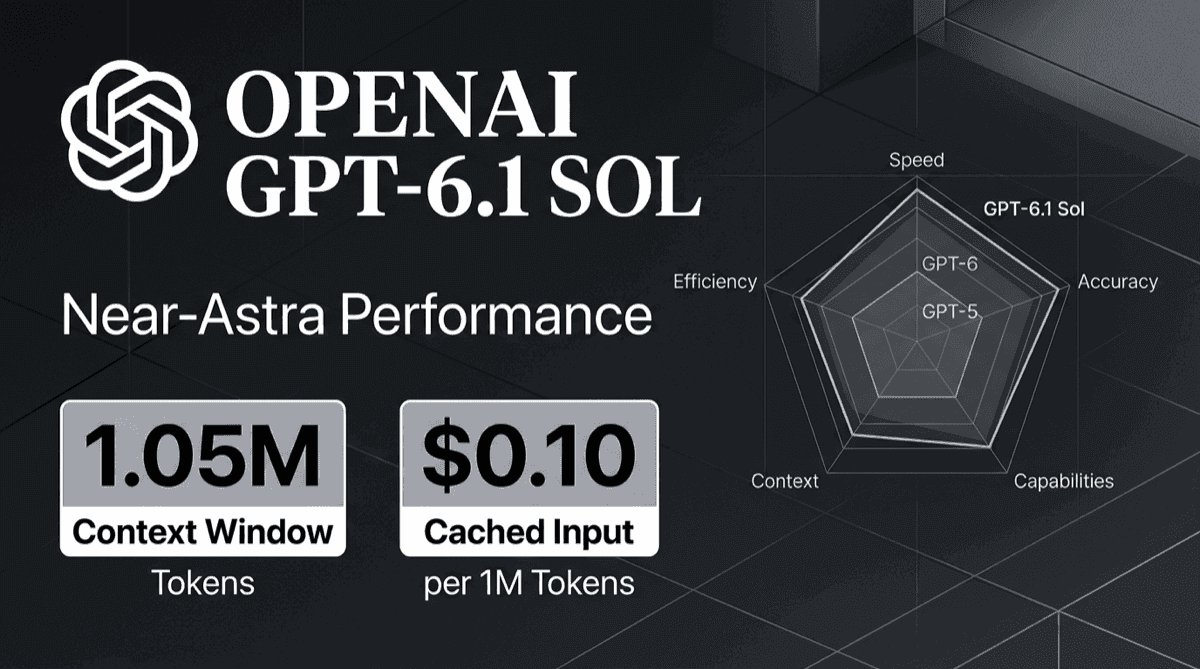
OpenAI has released GPT-6.1 Sol, an upgraded mid-tier model delivering near-Astra intelligence for complex coding, computer use, and enterprise automation. Featuring a 1.05M-token context window and a 95% prompt caching discount, it establishes a new price-to-performance benchmark for production developers.
What’s New
- Delivers near-Astra intelligence across complex software engineering, computer use, and agentic workflows.
- Maintains $2.00 per million input and $10.00 per million output tokens, while cutting cached input pricing by 95% to $0.10 per million tokens.
- Outperforms GPT-6 Sol on DeepSWE v1.1 by 6.4 percentage points and matches GPT-6 Astra at one-fifth the inference cost.
- Features a 1.05 million token context window and a 128,000 maximum output token capacity.
- Available across the OpenAI API, ChatGPT Work, and Codex for Plus, Pro, Business, Enterprise, and Edu tiers.
Why It Matters
GPT-6.1 Sol delivers frontier-class agentic execution without the flagship price tag. By pairing near-Astra coding capabilities with a 95% prompt caching discount, OpenAI makes long-horizon autonomous software pipelines economically viable at scale.
Just one week after introducing the GPT-6 generation, OpenAI has launched GPT-6.1 Sol during its DevDay announcements. The release acts as an aggressive architectural revision to the mid-tier GPT-6 Sol model, directly targeting agentic software engineering, autonomous computer use, and multi-step enterprise workflows. Rather than waiting for a distant release cycle, OpenAI updated the model to bridge the gap between production economics and flagship frontier capabilities.
OpenAI describes GPT-6.1 Sol as providing near-Astra intelligence at an operational cost low enough to sustain recursive agent loops. While the flagship GPT-6 Astra remains the recommended system for frontier scientific discovery and specialized mathematics, GPT-6.1 Sol is positioned as the primary execution engine for daily software development and high-context business reasoning.
Performance benchmarks and coding evaluations
The defining story of GPT-6.1 Sol lies in its benchmark jumps over the original GPT-6 Sol release:
- DeepSWE v1.1: GPT-6.1 Sol gains 6.4 percentage points over GPT-6 Sol. On this evaluation, it matches the pass rate of GPT-6 Astra while operating at approximately 20% of the flagship model's total cost.
- OSWorld 2.0 (Offline): On multi-step desktop computer use tasks, the model registers a 7 percentage point increase over GPT-6 Sol when configured at maximum reasoning effort.
- AutomationBench 1.0.6: At medium reasoning effort, GPT-6.1 Sol improves by 4.8 percentage points over its predecessor. It also edges past Anthropic's Claude Opus 5.5 by 2.2 percentage points on identical workflow evaluations.
- Terminal-Bench Science 0.1: When tested on command-line terminal reasoning and scientific execution at maximum effort, GPT-6.1 Sol more than doubles the benchmark score achieved by the initial GPT-6 Sol.
On composite leaderboards, third-party evaluators have confirmed the step change. Artificial Analysis ranked GPT-6.1 Sol at an Intelligence Index score of 52 at maximum effort, placing it just one point shy of GPT-6 Astra. On the BenchAlign leaderboard, the model secured the number 23 position overall with a 66.86 rating.
Token economics and 95% prompt caching
While frontier reasoning models frequently strain enterprise budgets during recursive agent loops, OpenAI maintained the baseline pricing of the original Sol model:
- Standard Input: $2.00 per 1 million tokens.
- Standard Output: $10.00 per 1 million tokens.
- Cached Input: $0.10 per 1 million tokens.
The critical commercial lever is prompt caching. By slashing cached input token prices to $0.10 per million, OpenAI offers a 95% discount compared to uncached input and a 50% discount compared to the original GPT-6 Sol. For software engineering agents that repeatedly load large codebases, unit tests, and persistent system prompts into the context window, prompt caching dramatically lowers the cost of long-horizon execution.
Architectural parameters and developer tooling
GPT-6.1 Sol inherits the massive 1,050,000-token context window and 128,000 maximum output token ceiling introduced with the GPT-6 architecture. This capacity allows developers to pass hundreds of files, full dependency graphs, and entire terminal logs directly into memory without aggressive chunking or lossy summarization.
The model supports multiple reasoning effort levels: low, medium (the default setting), high, xhigh, and max. In a departure from earlier general models, OpenAI disabled none and minimal reasoning modes. Every request enforces structured chain-of-thought processing, reflecting OpenAI's intent to treat Sol purely as a reasoning and execution model. Tool calling requires integration through OpenAI's Responses API, standardizing how external functions, web browsers, and terminal sandbox tools are executed.
Safety classifications and enterprise availability
Under OpenAI's Preparedness Framework, GPT-6.1 Sol is categorized as "Critical" for cybersecurity capabilities and "High" for chemical and biological risks. As a result, the model runs on the same enhanced safety and monitoring stack as GPT-6 Astra, including automated anomaly detection on recursive tool execution and red-teaming protections against jailbreak attempts.
Access to GPT-6.1 Sol is rolling out immediately. Developers can call the model in production via the API under the identifier gpt-6.1-sol. For end users, the model is accessible through ChatGPT Work and Codex for paid subscribers on Plus, Pro, Business, Enterprise, and Edu plans. Consumer ChatGPT tiers will continue to route queries through standard general-purpose models, keeping GPT-6.1 Sol focused on professional and software engineering workloads.