Mistral Launches Mistral Large 4: 1T Open-Weight MoE with Sovereign Infrastructure
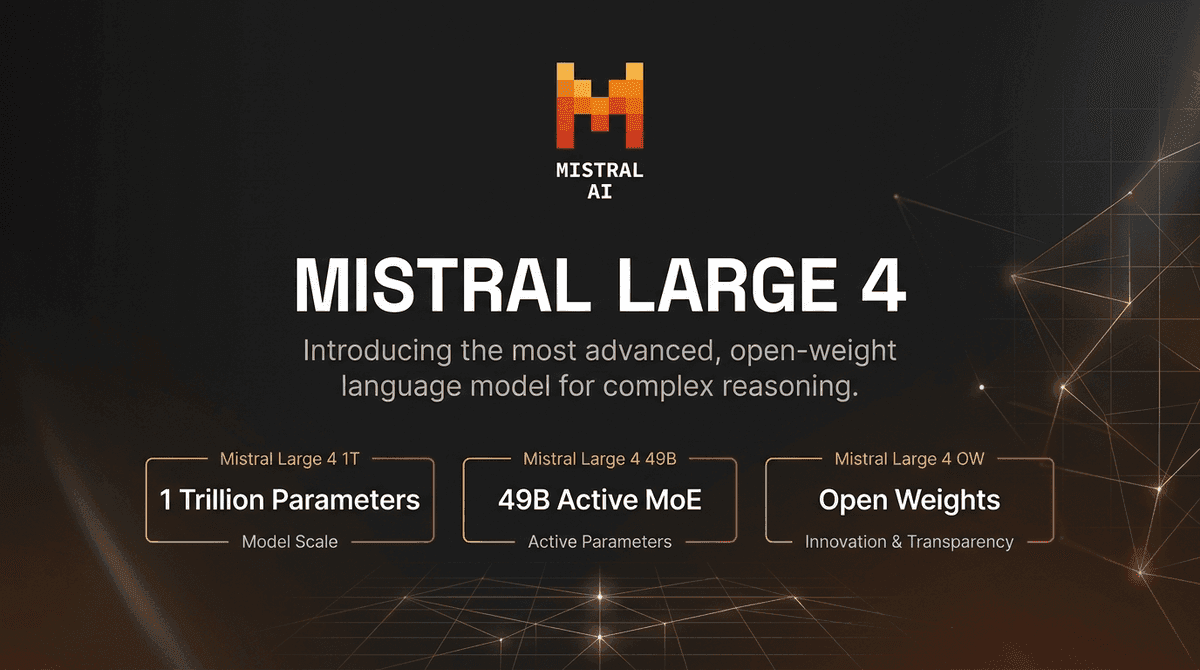
Mistral AI has unveiled Mistral Large 4, a 1-trillion-parameter multimodal Mixture-of-Experts model with 49 billion active parameters. Trained on 3,800 NVIDIA Grace Blackwell GPUs in European datacenters, the open-weight model sets new frontiers in cybersecurity, coding, and enterprise automation.
What’s New
- Features a 1-trillion-parameter sparse MoE architecture with 49 billion active parameters per forward pass.
- Trained entirely on 3,800 NVIDIA Grace Blackwell GPUs within Mistral sovereign European datacenter infrastructure.
- Leads global models in cybersecurity with an 82% patch reproduction score and 93% success on Cybench.
- Outperforms open competitors on DeepSWE v1.1 (61.7%) and achieves 59.9% on AutomationBench enterprise workflows.
- Available today via preview API at $1.36 per million input and $4.18 per million output tokens, with open weights dropping by late October.
Why It Matters
Mistral Large 4 shifts the frontier of open weights by pairing commercial-grade coding and visual grounding with sovereign, private-cloud deployment. For security teams and enterprises constrained by closed model refusals and foreign data jurisdictions, it delivers an independent alternative to US and Chinese foundation models.
Mistral AI has introduced a public preview of Mistral Large 4, internally dubbed ML4 and affectionately nicknamed le Chonk. The model represents the Paris-based laboratory's most ambitious training run to date: a 1-trillion-parameter sparse Mixture-of-Experts (MoE) architecture activating 49 billion parameters dynamically during inference. Built from the ground up on European sovereign compute, the model marks the first major milestone financed by Mistral's record-breaking 3 billion euro Series D funding round.
The release challenges the performance dominance of proprietary US frontier systems and open Chinese releases. While preview API access is live immediately on Mistral Studio, Mistral confirmed that the open weights will be released publicly by the end of October 2026, granting organizations full autonomy to deploy the system on-premises or within air-gapped infrastructure.
Sovereign European infrastructure and hardware scale
A central pillar of the Mistral Large 4 announcement is infrastructure sovereignty. The foundation model was trained entirely from scratch on a cluster of 3,800 NVIDIA Grace Blackwell GPUs hosted within Mistral's proprietary datacenters in Europe. The public preview API runs on this identical European infrastructure, operating independently of third-party hyperscalers and subject strictly to European legal frameworks.
Training data for ML4 encompassed more than 160 languages, including every official language of the European Union, alongside domain corpora sourced across aerospace, pharmaceuticals, manufacturing, shipping, and financial regulation. The model was post-trained using the same reinforcement learning and fine-tuning harness provided to enterprise clients via Mistral Forge. At full scale, the distributed training pipeline generated approximately 33 billion rollout tokens per day, filtering down to 16 billion trainable tokens daily across complex tool-augmented environments.
Uncensored defensive cybersecurity capabilities
ML4 achieves its most striking differentiation in software security and vulnerability research. On the Artificial Analysis Cyber Index, an independent benchmark evaluating automated flaw discovery and remediation, ML4 ranks among the top five systems worldwide and leads all non-Chinese open-weight releases.
- Vulnerability Patching: When tasked with reproducing and repairing verified vulnerabilities in production open-source software, ML4 achieved an 82% resolution rate, the highest score recorded across all evaluated models.
- Cybench Competition Tasks: The model solved 93% of the 40 adversarial challenges drawn from professional cybersecurity competitions.
- Overcoming Refusal Bottlenecks: Closed proprietary models such as Claude Opus 5.5 and GPT-6 Astra recorded near-zero scores on identical tests because commercial safety filters routinely flag reverse-engineering and exploit reproduction as malicious activity. By contrast, ML4 provides defensive engineers with an unconstrained, auditable foundation model capable of malware analysis, log triage, and detection rule synthesis under their own security governance.
- Adversarial Robustness: On Lakera's public B3 AI Security Benchmark, ML4 withstood 93.3% of indirect prompt injection attacks, while scoring 1.691 out of 2.0 on the KORA safety benchmark.
Agentic coding and long-horizon workflows
In software engineering, ML4 demonstrates major gains over prior European and American open-weight systems:
- DeepSWE v1.1: ML4 scored 61.7%, complemented by 59.4% on SWE-Atlas-QnA and 28.3% on Terminal-Bench 4.0.
- Coding Agent Index: Its composite score of 49.8% places it ahead of competitive open weights including DeepSeek V4 Pro and Qwen3.8 Max.
- Blind Human Annotations: In a double-blind evaluation conducted by Surge AI with professional developers, ML4 scored 3.74 out of 5, outperforming Kimi K3 (3.59) and GLM-5.3 (3.60), trailing only Claude Opus 5 (4.22).
- AutomationBench: Across 657 realistic enterprise automations spanning Google Sheets, Slack, Gmail, and Salesforce, ML4 posted a 59.9% success rate.
- AA-Briefcase: On multi-document knowledge work evaluating spreadsheet synthesis, presentation construction, and memo drafting, the model reached 1,393 Elo.
Multimodal perception and domain specialization
Unlike previous text-first releases, Mistral Large 4 is natively multimodal. The vision encoder was engineered specifically for heavy industrial and engineering perception rather than simple web imagery:
- Visual Grounding: On the Dense 200 spatial grounding benchmark, ML4 registered 42% accuracy, edging past GPT-6 Astra (41%). The model demonstrates specialized competency in dissecting gigapixel satellite maps, reading dense mechanical CAD schematics, and verifying component tolerances in technical blueprints.
- Scientific Code Generation: On SciCode-Verified, ML4 set a new state of the art among open-weight architectures, demonstrating the capacity to generate full Hartree-Fock physical chemistry simulations in a single conversational pass.
- Legal and Corporate Finance: In independent evaluations conducted by Vals.ai, ML4 surpassed GPT-6 Astra across complex contract extraction and multi-filing financial statement analysis, taking the top spot on HarveyAI's Legal Agent evaluation.
Pricing and commercial rollout
Developers can test Mistral Large 4 today through Mistral Studio. API pricing is positioned aggressively:
- Input Tokens: $1.36 per 1 million tokens.
- Output Tokens: $4.18 per 1 million tokens.
Mistral stated that the current preview model is still undergoing active reinforcement learning iterations. With the complete model weights scheduled for release before November 2026, ML4 establishes an open, sovereign baseline for enterprises seeking frontier reasoning without vendor lock-in.