OpenAI Launches GPT-6 Sol and Luna for High-Efficiency Agentic Workflows
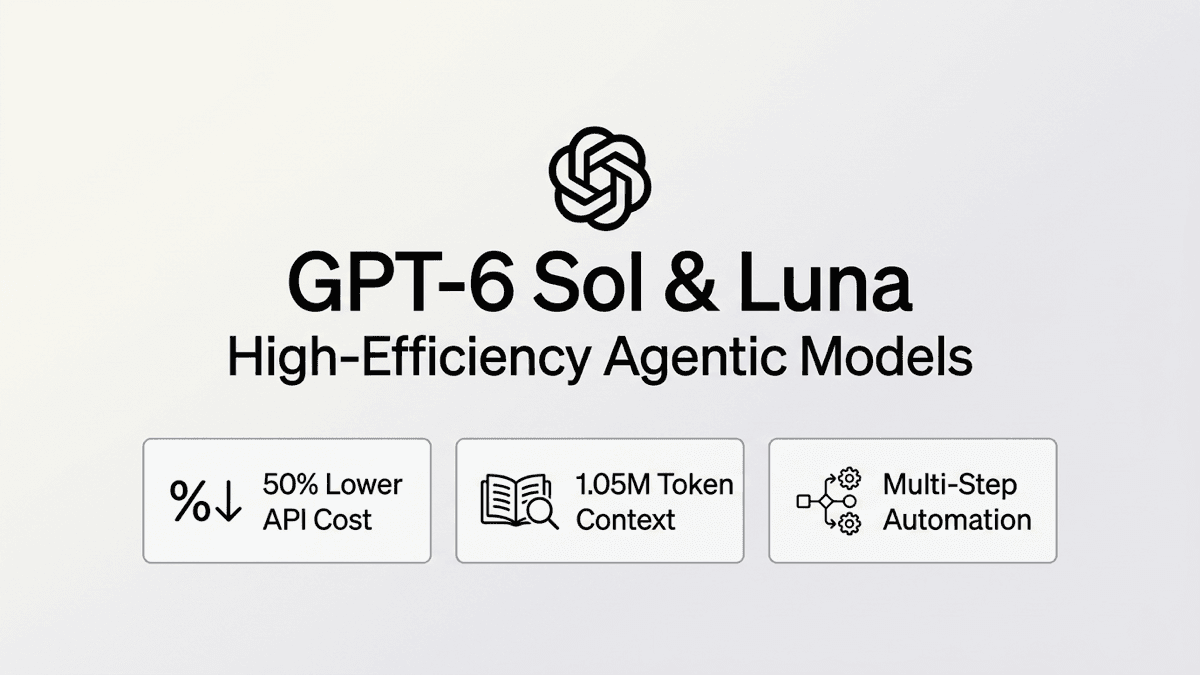
OpenAI has introduced GPT-6 Sol and GPT-6 Luna, expanding the GPT-6 lineup with high-efficiency models designed for production automation. Featuring 1.05M-token context windows and a 50% price reduction, the models deliver cost-effective agentic execution across enterprise workflows.
What’s New
- Introduces GPT-6 Sol for multi-step agentic coding and professional research, and GPT-6 Luna for high-throughput extraction and routing.
- Cuts API pricing by 50% compared to the GPT-5.6 series, pricing Sol at $2/$10 and Luna at $0.10/$0.50 per million input/output tokens.
- Equips both models with a 1.05 million token context window and 128k output tokens for sprawling document and repository tasks.
- Sol scores 33.2% on AutomationBench at $0.27 per task, topping Claude Opus 5 and matching Claude Fable 5.1 at lower cost.
- Available across the OpenAI API, ChatGPT Work, Codex, Amazon Bedrock, and Microsoft Azure.
Why It Matters
GPT-6 Sol and Luna shift the economics of autonomous software and enterprise agents by cutting token costs in half while providing million-token contexts. For production teams scaling multi-app workflows, these models turn expensive agent experiments into viable production pipelines.
OpenAI has expanded its frontier model family with the release of GPT-6 Sol and GPT-6 Luna. Arriving alongside the flagship GPT-6 Astra, the two new models serve as specialized workhorses engineered to make long-horizon reasoning, agentic tool invocation, and large-scale data processing commercially viable for enterprise production.
Rather than competing purely on peak benchmark ceilings, Sol and Luna focus on cost-per-task efficiency and operational reliability. Both models come equipped with a 1.05 million token context window and 128,000 output tokens, allowing systems to ingest full enterprise codebases, financial filings, and multi-document compliance corpora in a single inference call.
Two tiers for production automation
OpenAI designed Sol and Luna to fill distinct operational roles across modern AI architectures:
- GPT-6 Sol: Positioned as the primary engine for complex, multi-turn reasoning and agentic software automation. Sol is tailored for developers orchestrating deep coding loops, multi-repository refactoring, and multi-app business workflows that require continuous tool verification.
- GPT-6 Luna: Optimized for high-throughput, latency-critical pipelines where unit cost is paramount. Luna targets programmatic classification, structured document extraction, automated ticket triage, and conversational customer-facing routing.
Pricing structure and efficiency metrics
To accelerate developer adoption, OpenAI reduced API pricing by 50% relative to the prior generation GPT-5.6 family:
- GPT-6 Sol: $2.00 per million input tokens and $10.00 per million output tokens.
- GPT-6 Luna: $0.10 per million input tokens and $0.50 per million output tokens.
By combining token-level price reductions with architectural efficiencies that reduce superfluous output verbosity, OpenAI claims the average task completion cost drops by 50% to 60% compared to previous frontier models.
Benchmark evaluations and real-world results
On multi-tool automation and enterprise evaluations, OpenAI reported significant performance gains over prior model iterations:
- AutomationBench 1.0.6: Evaluating multi-step business actions across 47 real-world SaaS tools, GPT-6 Sol scored 33.2% at extra-high reasoning effort. This outpaced Claude Opus 5 (26.9%) and rivaled Claude Fable 5.1 (31.4%), while reducing cost per completed task to an average of $0.27.
- Agents' Last Exam: On economic workflows across 55 diverse sub-industries, Sol scored 56.4% at max effort, outperforming Opus 5 while slashing execution expenses by 60%.
- DeepSWE v1.1: In autonomous software engineering benchmarks, Sol achieved a 68.8% success rate, matching frontier reasoning tiers at roughly one-fifth the inference cost.
- GPT-6 Luna: Delivered a 5.4 percentage point gain over GPT-5.6 Luna on standardized workflow benchmarks while reducing token expenditure by 58%.
Enterprise availability and ecosystem integration
GPT-6 Sol and GPT-6 Luna are available immediately via the OpenAI API under the model identifiers gpt-6-sol and gpt-6-luna. Enterprise and cloud developers can also access both models through Amazon Bedrock and Microsoft Azure.
Within OpenAI's consumer and team tiers, both models are accessible in ChatGPT Work and Codex for Plus, Pro, Business, Enterprise, and Education subscribers. In addition, GPT-6 Luna is available to Free and Go tier users on the ChatGPT desktop applications.